FAQ2026-05-13T09:19:47+00:00

Frequently Asked Questions

Click here for a printable version.

FAQ 1. Healthcare Professionals and Institutions Concerned2026-05-13T09:00:48+00:00

Doctors, pharmacists, nurses, vets, dentists, truss-makers, opticians, hospital directors, hospital equipment purchasers, chiropodists, midwives, laboratory directors, bio-medical operatives, wholesalers, physiotherapists, mediators, care workers , nutritionists, hospital technicians, clinical psychologists, etc.

In other words, all healthcare professionals who distribute, purchase (or arrange for the purchase of), prescribe, recommend, dispense, or administer medications and/or distribute, purchase (or arrange for the purchase of), rent (or arrange for the rental of), recommend, use, or prescribe medical devices, including the institutions where one or more of these actions take place (such as hospitals, nursing homes, private clinics, rehabilitation centers, home care services, and similar care facilities). Not only do the institutions themselves fall within the scope of application, but also all persons involved in the prescription, dispensing, administration, or use of medications and/or medical devices, such as a hospital director, hospital technicians, purchasing committees, etc. Not only do the institutions themselves fall within the scope of Article 10, but also persons who, within those institutions, are involved in the supply, prescription, dispensing, administration, or use of medicinal products and/or medical devices. This may be the case, for example, for a hospital director, hospital technicians, or members of purchasing committees, to the extent that they are involved in these activities in that capacity.

What about retired professionals? These individuals are only excluded from the scope of the licensing requirement if they no longer hold a license as provided for in Article 10 of the Law of April 22, 2019, on the professional practice of healthcare professions, nor do they have an INAMI number.

The visa procedure does not, however, apply to professional associations (unless benefits are granted, directly or indirectly through such an association, to healthcare professionals), nor to patients or patient associations.

Yes, if it concerns a healthcare professional (see FAQ 1.1).
In principle, it is not necessary to request a visa under these circumstances, unless the professional concerned exercises in his capacity as such in Belgium.
FAQ 2. Companies Concerned2026-05-13T09:01:32+00:00

Companies which in Belgium

  • manufacture, import, deliver and/or distribute medicinal products and/or
  • have a marketing authorisation for a medicinal product and/or
  • have a CE marking for a medical device and/or
  • manufacture, import, deliver, distribute and/or rent-out medical devices,
  • and invite or sponsor one or more healthcare professionals who practise in their capacity in Belgium to participate in an event of a scientific nature.

In other words, are concerned:

  • both pharmaceutical companies and companies of the medical devices sector
  • both Belgian companies and those from other countries
  • both manufacturers and distributors, wholesalers or importers.

As soon as there is a connection with the prescribing, dispensing, administering, or using of medicinal products or medical devices, Article 10 applies—regardless of the company’s other activities. A mixed portfolio within a company does not affect the applicability of Article 10. Example: a company that distributes both medicines and dietary supplements falls under Article 10, even if the majority of its activities fall outside the scope of the Act.

A visa is required once a healthcare professional is practicing or can practice in Belgium is invited or sponsored by a pharmaceutical company or a company from the medical devices sector, whether or not the company is based in Belgium.

FAQ 3. The Concept of ‘event of several days’2026-05-13T09:02:19+00:00

This is the legal wording coming from article 10 of the Law on medicinal products.

Two situations are concerned:

  • The scientific programme of the event takes place over several consecutive calendar days. Ex.: it commences on day A and finishes on day B (regardless of the actual duration of the sponsored professional’s participation: see FAQ 3.2).
  • The scientific programme of the event takes place on one single day (or less) but requires an overnight stay as the event takes place abroad. Ex.: an event commences in Paris at 8.00am and finishes at 4.00pm. Participants must arrive the night before in order to be punctual for the start of the event. The event as a whole therefore takes place over several consecutive calendar days, even though the programme lasts for less than one day.
Yes, a visa is required as the programme alone already takes place over more than one consecutive calendar day.

If a company organises a scientific meeting lasting less than a day where only a dinner and/or a lunch is being offered and that is taking place abroad because of a congress at the same time to which all the invited healthcare professionals are participating, then no visa is required if:

  • it lasts less than a day,
  • it has nothing to do with the congress taking place at the same venue and its agenda and invitation were set and sent out in advance (this is prior to the congress taking place at the same time),
  • it concerns an international public,
  • only a meal is being offered.

Please note: in that case, Circular No. 622bis of the Federal Agency for Medicines and Health Products has to be respected.

If, on the other hand, it concerns the sponsoring of only meals during a congress, see FAQ 8.4.

Sponsorship may only be granted or offered to the healthcare professional in question after the Mdeon visa has been granted.

This means that the company may make internal practical preparations prior to obtaining the visa, such as pre-booking or reserving flights, hotel rooms, or other logistical arrangements, provided that these are not transferred or definitively allocated to the healthcare professionals before the visa decision is made, nor in the event of a negative decision.

Every company must have internal procedures that clearly describe:

  • How to submit the visa application;
  • Which department or person is responsible for the application;
  • How Mdeon’s decision—whether positive or negative—should be communicated to the healthcare professional.
FAQ 4. Scientific Programmes2026-05-13T13:09:53+00:00

A scientific programme is considered to be detailed when it contains per day:

  • detailed timetable (not only from 9.00am to 12 noon and from 1.00pm to 5.00pm but per units of 20 or 30 minutes, for example, or per topic), also mentioning the date of the meeting.
  • and a detailed content (not only the nature of the sessions but also the title of each scientific topic and, if possible, the names of the speakers). The content must be sufficiently clear so that the Visa Bureau understands what it is about. If too much jargon or uncommon abbreviations are used, this should be clarified to enable the Visa Bureau to properly exercise its control powers.

Please note that only programs of a purely scientific nature in the context of the medical and pharmaceutical science are allowed (see FAQ 5.1).

A preliminary programme may suffice with the proviso that it is detailed for each day in terms of content and timetable.

The company may submit a request for a visa as long as the following is included at the time of the submission:

  • the provisional programme as available at the moment of submission of the visa,
  • the detailed programme of the previous edition,
  • and a confirmation by the organiser (by email) or by the company of the date at which the detailed programme will be available. This date must be no later than three months before the event; the company will otherwise have to await the publication of the detailed programme before applying for a visa.

After having obtained a visa on this basis, it is incumbent on the company to verify that the detailed programme, once available, does not differ in any way from the previous application. If this were not to be the case, a new request for a visa would have to be submitted as a result of the substantial modification to the programme.

However, the above-mentioned does not apply:

  • to events taking place for the first time
  • to events organised by a company
  • to visa requests concerning sponsorship of scientific organisers (V2).

In these cases the request for a visa should only be made once the detailed programme (provisional or definitive) is ready.

As far as meetings for investigators are concerned, it is important to briefly explain in the visa submission (or in an appendix) what the clinical trials consists of and its aims. If uncommon abbreviations are used in the summary of the programme, they must be explained. Some meetings for investigators are in fact so full of abbreviations that the Visa Bureau is not in a position to verify if the event is a purely scientific one.

If the scientific event is organised by a company (or by a third party on behalf of a company), no social or cultural activity may be organised – even if healthcare professionals participating are paying for any such activity.

If the event is organised by healthcare professionals or other associations independent of companies, it is allowed to organise a social or cultural event, but only on the condition that

  • it is not part of the scientific program (e.g. not during the day, but in the evening after the scientific sessions ended), and
  • it is financed from other funds than those issuing from medical devices or pharmaceutical companies.

For a definition, see Article 3.2 of the Code of Ethics.

A purely virtual scientific event is subject to a visa requirement if it takes place over several consecutive calendar days and if its registration fee is paid (cumulative conditions). In this case, a supporting document of the registration fee (price + what is included) must always be attached: for more info see FAQ 9.4.

In the case of purely virtual participation, the hospitality offered is limited to the registration fee (meals or other hospitality may under no circumstances be offered).

For purely virtual scientific meetings, there is no minimum number of hours of scientific activities. For example, a virtual scientific program of 4 hours may be spread over 2 hours on day X (from 6 pm to 8 pm) and another 2 hours on day X+1 (from 8 am to 10 am).

FAQ 5. Types of Scientific Events2026-05-19T09:54:40+00:00

5.1.1. In general

For all types of events of a purely scientific nature: national or international congresses, investigator meetings, expert meetings, symposia, seminars, scientific satellite symposia, training sessions on the proper use of medicines or medical devices, scientific training sessions, advisory boards, live surgery meetings, scientific information sessions, etc. For a definition of each of these scientific meetings, please refer to the Guidance of the FAMHP.

The following events do not meet the legal scientific criteria and therefore may not be sponsored: events without a scientific program, events of a promotional nature, satellite symposia of a promotional nature, workshops featuring product demonstrations, local quality groups (“LOK” or “GLEM”), interdisciplinary consultations, product-oriented training sessions, open houses, business lunches or dinners, non-scientific presentations, social events. For a definition of each of these events, please refer to Guideline Art. 10 of the FAMHP or section 5.1.2 below.

Certain topics, presentations or workshops can perhaps be interesting for the participating professionals, but are not in the context of the medical or pharmaceutical science. See for example presentations and workshops on financial, tax or social aspects linked to the exercise of a practice or “train the trainer” sessions. If such activities are planned, then also purely scientific activities need to be scheduled occupying the greater part of each day of the event.

In order to present an exclusively scientific nature, the activities of a scientific nature must always occupy the greater part of each day of the event, from the arrival until the moment of departure. One day must include at least six hours of scientific activities (excluding breaks), during normal office hours (and therefore not for example 7 am – 1 pm). For the first day and the last day, three hours may be sufficient to allow arrivals and departures.

5.1.2. Definitions

All definitions of the meetings mentioned above can be found on pages 15–18 of the FAMHP Guidance (Dutch versionFrench version).

Factory visits are not allowed. However, the following situations are permitted at manufacturing facilities:

  • Product or procedure training of medical devices that can only take place in the factory because of the relevant expertise or infrastructure in place; in this case, however, it does not constitute a factory visit, as this is secondary to the primary objective (the scientific training).
  • In the event of a major scientific added value for the participating professionals, which must be substantiated and justified. The motivation must prove, among other things, why the scientific event cannot take place in Belgium. Moreover, if the factory visit is to be preceded by presentations on theoretical aspects, the latter must represent a maximum of a third of the program, if not the transfer abroad is not justified for the entire duration of the meeting.Merely demonstrating production or other processes or speaking with employees involved in these activities does not constitute significant scientific added value within the meaning of the legislation. Significant scientific added value can only consist of training or the provision of information indispensable to the proper practice of medical and pharmaceutical practice, which must be clearly demonstrated in the visa application.
FAQ 6. Sponsoring of Organizers (V2)2026-08-28T11:06:45+00:00

A scientific event organized by a third party may be organized by a separate company specializing in conference organization or by an organization in the healthcare sector. When such a scientific event is sponsored by industry, a visa (V2) is required in the following cases:

  • For events that take place over several consecutive calendar days;
  • And that 1) are organized by an association managed by a majority of healthcare professionals practicing in Belgium and/or 2) bring together a majority of healthcare professionals practicing in Belgium.

In this case, it is the responsibility of the scientific organizer of the event to submit the V2 visa application and to list all the meeting’s sponsors. The visa number obtained must then be included in all correspondence with the sponsors to inform them that the sponsorship proposal offered complies with legal and ethical provisions. In fact, the visa must be obtained before any funds are paid to the organizer. Sponsors are jointly and severally liable with the organizer for compliance with the visa requirement.

A company that additionally sponsors certain healthcare professionals to participate must submit a separate visa application (V1), independent of the organizer’s consolidated visa application for sponsorship. Under no circumstances may a company submit a V2 visa application on its own. Only when the organizer has already obtained a V2 visa but has not listed a specific company as a sponsor may that company join the application via a V2 visa application, as a substantial modification to the V2 visa already obtained.

The sponsoring of scientific events is permitted only if the sponsorship is clearly and exclusively used for the scientific component of the event.

What can be sponsored?

A company may contribute financially to the organization of a scientific event, for example by covering:

  • venue rental,
  • technical support (such as audiovisual and IT support),
  • speakers’ fees,
  • printing costs,
  • catering (provided it is limited to the scientific program).

What is not permitted?

Sponsorship of activities that do not meet the requirements of a scientific event, such as:

  • social activities,
  • recreational activities,
  • promotional activities (including booths: see below),
  • non-scientific presentations;
  • etc.

Furthermore, the sponsoring company may not exert any influence over:

  • the program content,
  • the selection of speakers,
  • the event’s target audience.

The sponsoring of scientific events is permitted only if the funds are clearly and exclusively used for the scientific component. The sponsoring company, the organizer, and any healthcare organizations share the responsibility for ensuring the proper, transparent, and verifiable use of the funds.

To prevent the funds referred to in Article 10 from being used for activities that do not meet the requirements of a scientific event, it must be clearly established in each case which costs specifically fall under the scientific component and how these are funded.

For this reason, there must always be a strict separation between activities with scientific content and those without (such as social, recreational, and promotional activities—including booths—non-scientific presentations, etc.). This separation must be demonstrable at all levels, particularly with regard to content, organization, facilities, programming, and funding, in order to prevent any confusion or undue influence.

The specific conditions for this separation are as follows:

  • The promotional or social component must be clearly separated from the scientific program and must not be part of it.
  • Social or recreational activities may not interrupt the scientific program or take place during it. They must occur exclusively before or after the scientific portion.
  • The non-scientific portion must not undermine the scientific character of the event.
  • There must be no confusion regarding the purpose or nature of the meeting; the scientific approach must remain central at all times.
  • Sponsorship by companies covered by Article 10 may only pertain to the scientific portion of the event.
  • No form of hospitality may be offered at company booths, with the exception of water, coffee, tea, non-alcoholic beverages, or other similar basic services.

The organizer remains fully responsible for the scientific independence and transparency of the event. In certain cases, a company’s contribution may help cover all or part of the participants’ registration fees or hospitality expenses, but this is permitted only to the extent that these costs relate exclusively to the scientific component of the event.

The organizer must at all times be able to demonstrate that the separation between the scientific program and other components is complete and verifiable. This means that financial flows must be clearly and unambiguously distinguishable, so that an audit can immediately determine which funds were specifically allocated to the scientific component. In this way, any confusion with social, recreational, or promotional components is ruled out. Revenue may therefore not be deposited into a single fund, as there is then a real risk that resources from companies covered by Article 10 could indirectly finance non-scientific activities, which is strictly prohibited.

It is strongly recommended that all parties involved retain detailed and verifiable supporting documentation that clearly identifies the funds received, their source, and the specific expenses for which they were used. The supporting documentation must unequivocally demonstrate that the funds were spent exclusively on the scientific component.

When a company contributes to the organization of an exclusively scientific event, it is recommended to have, prior to the granting of funding, the necessary documents certifying compliance with legal requirements. This includes, at a minimum:

  • the detailed scientific program;
  • the approved Mdeon V2 visa (if applicable);
  • a budget estimate received from the organizer, indicating the anticipated expenses for organizing the scientific event.

After the event, the organizer must have the following documents and be able to present them to the company:

  • invoices, proof of payment, and VAT receipts;
  • a detailed breakdown of expenses;
  • a comprehensive overview of income and expenses, clearly demonstrating that the funds received were not used for non-scientific, promotional, or social activities.

The financial report must include, at a minimum, the sections described in Annex A of the FAMHP guidelines. Expenses related to non-scientific activities must always be documented separately, with a clear indication of the party that covered these costs, so that, in the event of a control, it can be immediately determined how the funds were used.

Transparency and full traceability of financial flows are essential. All parties involved must keep documents available for inspection for 10 years.

! To avoid any confusion, it is recommended that financial flows be organized in such a way as to ensure a complete, clear, and traceable separation between the funds related to the scientific program and those related to the non-scientific component. Any contribution from other parties to the funding of the non-scientific component is permissible only if the contribution is organized and documented entirely separately from the scientific program, through separate and traceable financial flows, so that an inspection can unequivocally determine the origin and use of the funds. In any case, there must be no confusion whatsoever: the non-scientific component must under no circumstances be presented as being made possible, directly or indirectly, by the presence or support of pharmaceutical or medical device companies.

! The perception of healthcare professionals is also decisive: any impression that the non-scientific component is made possible, directly or indirectly, by the presence of pharmaceutical or medical device companies constitutes a prohibited indirect benefit. For this reason, the non-scientific component must under no circumstances be presented or communicated as being, even indirectly, linked to pharmaceutical companies or medical device companies.

Any funding provided by a company must be set forth in a single written contract between the sponsoring company and the organizer or healthcare organization. This contract must be clear and comprehensive and contain at least the following elements:

  • The purpose of the funding;
  • An estimate of the costs covered;
  • A clause regarding compliance with Article 10;
  • The obligation to provide supporting documentation following the event;
  • A provision regarding the handling of unused funds;
  • And, where applicable, the obligation to communicate Mdeon’s V2 approval to the sponsoring company and/or participants.

If the organizer is itself a beneficiary as provided for in Article 10, retaining the amount or a portion of the unused funds may constitute a violation of the law. In such cases, unused funds must always be refunded to the sponsors or used in accordance with the legal provisions. Beneficiaries are under no circumstances permitted to retain any remaining funds.

Payment by companies to an event organizer for a booth space is considered a purely commercial transaction. It constitutes compensation in exchange for a specific service or benefit provided by the organizer (for example, the provision of a booth space, technical support, logistical services, or visibility).

As long as the payment is limited to the commercial service provided by the organizer, it is not considered a premium or benefit within the meaning of Article 10.

It is, however, essential that the company pay a fair and market-based price, proportional to the nature and scope of the services provided. The remuneration must be transparent and based on objective criteria, such as the location, size, duration of use, technical assistance, and visibility of the booth. In principle, the same pricing terms should apply to all companies for the same services and facilities. These conditions and pricing agreements must be clearly set forth in a written contract between the organizer and the company.

Although payment for the booth space is in itself a permissible commercial transaction, this payment may under no circumstances—either directly or indirectly—be used to  grant an advantage to healthcare professionals.

Consequently, the payment made for a booth may not be used to cover the registration fees of healthcare professionals; travel or accommodation expenses (such as transportation, hotel, meals); any form of hospitality, whether at the company’s booth or elsewhere during the event; or the funding of conferences, presentations, or other non-scientific program elements that could be considered a benefit to healthcare professionals.

If the payment for the booth space is used in whole or in part to finance direct or indirect benefits for healthcare professionals, the transaction loses its commercial nature. In this case, it constitutes a prohibited benefit.

For a brief summary, click here.

6.9.1  The organizer of a scientific conference taking place in Belgium has a visa number for its sponsors. Do I need a separate visa number if my company invites professionals to the same conference?

Yes. This is in fact a different form of sponsorship, namely the sponsorship of “participants” (rather than the organizer), which requires a specific visa application using the “V1” visa application form titled “sponsorship of participants in a scientific conference.”

6.9.2  Is a visa required when a company sponsors the organizer of an event taking place abroad?

Yes, if the meeting is organized by an association (or on behalf of an association) led by a majority of healthcare professionals practicing in Belgium, or if the majority of participants are healthcare professionals practicing in Belgium.

6.9.3  What is a detailed budget?

A budget consists of at least two columns: revenue and expenses. Revenue includes registration fees for the meeting (a preliminary estimate), industry sponsorship, any grants, any equity capital, etc. The expenses column summarizes all meeting expenses, broken down by expense category and corresponding amounts. For a detailed budget template, click here.

If the sole source of revenue is industry sponsorship and the total amount is used by the organizer to cover all incurred costs, expenses related to hospitality (lunch, dinner, accommodation, etc.) must not exceed the maximum amounts specified in FAQ 8.1, and no social or cultural activities may be planned.

If it is a scientific event (such as a conference) that does not consist exclusively of scientific aspects (such as booths, social activities, non-scientific themes, etc.): see FAQ 6.3–6.5.

6.9.4  Does the budget have to be balanced?

Not necessarily. However, the organizer must state in the visa application that any profits generated will be refunded or used in accordance with Article 10 of the Law of March 25, 1964, on Medicines. Furthermore, by submitting the visa application, the organizer agrees to notify the Mdeon Secretariat via email of the amount and allocation of the final accounts within three months of the end of the scientific meeting.

FAQ 7. Arrival and Departure – Days and Times2026-04-28T07:40:10+00:00

Approval would be given in such a case but healthcare professionals must then finance the additional dinner and overnight stay themselves as it would be, in principle, reasonably possible to arrive in Paris on the same morning (leaving Brussels via Thalys, for example at 7.30am or 8.15am) and arrive in time for the start of the event (unless a particular reason for not so doing was declared in the visa submission). The same reasoning would apply for other destinations, such as Amsterdam, London, etc.

Arrival and leaving dates must coincide as closely as possible with the opening and closing times of the scientific event. Choosing a direct flight which would mean that the healthcare professional would come back later than if he or she had taken an indirect flight is, therefore, not acceptable unless the indirect flight does not present a reasonable alternative (for example where the indirect flight would arrive at destination in the middle of the night).

This would be acceptable but the healthcare professional would then have to finance the additional cost of the overnight stay and the evening meal him/herself -save for reasonable justification and motivation- as it would have been reasonably possible to return home before midnight. However, if it is not reasonably possible to return home before midnight, an additional night may be approved provided this is properly justified in the visa application.

FAQ 8. Meals and Overnight Stays2026-04-28T12:52:04+00:00

GENERAL RULES around the provision of meals (for consultants: see below)

  • Meals may only be offered immediately before, during or immediately after a scientific activity (i.e., not along the way, at an airport or train station).Indeed, in accordance with Article 5.2 of Mdeon’s Code of Ethics, the hospitality offered must be strictly limited to the official duration of scientific activities. This means that a meal can only be offered during scientific activities, if it immediately precedes the start of scientific activities or immediately follows the end of scientific activities.  Examples:
    • It is permitted to offer a meal after a meeting abroad if it is impossible to return to Belgium that day and if the dinner coincides with the end of the scientific program (if the program ends before 5.30 PM, dinner cannot be offered).
    • It is permitted to offer a lunch before the start of the scientific event, only if the scientific event starts before 2.30PM (if the program starts after 2.30 PM, lunch cannot be offered).
  • There is a maximum of 45 euros for a lunch (drinks included), 90 euros for a dinner (drinks included) and 23 euros for a coffee break.
  • However, a maximum of 135 euros per day with at least 6h of scientific program must be taken into account. If a day does not include 6 full hours of scientific program, a total maximum of 23 € per full hour of scientific activity may be spent on meals. The amount of 23€/full hour* of science is all inclusive (drinks, coffee breaks, VAT, room rental, etc.).
  • Offering dinner on the eve of a scientific event may only be offered if there is a scientific program that eve.

* Calculation of the duration of the scientific program 

  • Maximum 23€ per full hour of scientific program may be offered for meals, to be divided proportionally over the entire time spent on pure science. A scientific program lasting 2h30 will thus entitle you to a meal of maximum 57,5€ (23€ x 2,5).
  • Note: when calculating the duration of the scientific program, only the actual scientific program is taken into account. As a result, lunch breaks, coffee breaks, reception of participants, etc. without demonstrated scientific content may not be included in this calculation.
  • The maximum amount of 45€ for a lunch, 90€ for a dinner and 23€ for a coffee break must be respected at all times.
  • Amounts may not be transferred: e.g., if there is a scientific program of at least 6 hours but less than 135€ is offered in meals, the remaining amount may not be transferred to the day after or before. The amounts are calculated day by day based on the scientific program of that day itself.

EXCEPTIONS FOR CONSULTANTS

participant is a healthcare professional who participates in a scientific meeting to learn.

consultant is a healthcare professional who, in the context of a scientific event, performs scientific services on behalf of the event organizer or on behalf of a pharmaceutical/medical device company. Usually (but not always) this person receives an honorarium for this. Examples: speaker, expert meeting, participation in an investigator meeting (study nurses included), etc. Is not a consultant: poster presentation, reporting afterwards, etc.

The following exceptions apply to consultants:

  • Meals that do not directly follow the scientific program (or meals offered on the eve) and/or that are more expensive may be offered provided they are justified and described (amount to be specified) in a contract. However, the price of the dinner offered must always be reasonable/legitimate and comply with the authorized amounts as described above, unless there is a reason justified by circumstances to offer a more expensive dinner.
    • A justifiable reason is, for example, a dinner with foreign consultants to avoid that only the Belgian consultants have to get another (cheaper) meal or are completely excluded from a meal, thus not being able to eat together with their peers and therefore not being able to talk about science. This reason must be explained in the visa application.
    • Another justified reason is a consultant who is going to give a training of several hours in several hospitals (“speaker tour”). In that case, this consultant will also be able to get meals at times that are not directly related to the training insofar as this is contractually provided for (e.g. giving training every evening will henceforth also entitle him to receive a lunch).
  • This contract will be attached to the visa application, which will also include the reference to the relevant article of the contract.
  • The rules for consultants apply only to meals that can be directly linked to services performed in their capacity as consultants. If a consultant presents a topic at a conference but then further participates in his capacity as a participant, a difference should be made in hospitality offered.
  • The capacity of consultant must be evidenced by supporting documents.

The maximum price per night is 250 € (including breakfast and taxes).

There is an exception for countries for which, according to the Ministerial Decree of January 14, 2025 (click to consult this decree in French or Dutch), the limit exceeds the maximum accommodation fee of 250 €. For these countries (and only for these), exceptions can be granted under the following cumulative conditions:

  • At least 5 hotel offers are attached to the visa application showing that it is not possible to comply with the €250 price, and the cheapest offer is chosen;
  • The hotels must be located within a reasonable distance (max. 10 km) from the place of the scientific event;
  • The chosen hotel meets the reasonableness criteria as described in the Mdeon Code (article 5); for example, not known for its luxurious reputation.

More specifically, this applies to the following countries (and only these): Anguilla, Bahamas, Barbados, Bermuda, Bhutan, Cayman Islands, China, Hong Kong, Djibouti, Dominica, Fiji, French Guiana, French Polynesia, Grenada, Iceland, Jamaica, Liechtenstein, Maldives, Mauritius, Mayotte, Mexico, Monaco, New Caledonia, Papua New Guinea, Saint Lucia, Saudi Arabia, Seychelles, Solomon Islands, Trinidad and Tobago, United Kingdom, United States of America.

Please note that the members of the Visa Office will verify that there are no reasonable cheaper options.

This is possible if he himself pays the additional cost compared to the maximum amount allowed by Mdeon. This must then be clearly stated in the visa application and must be able to be verified upon request by the FAMHP.

No, because the sponsoring must primarily be used for the sponsoring of a scientific event, which is not the case if only meals are offered. At least also something else that is necessary in order to take part in the scientific event must be sponsored (overnight stay, transportation, registration); if then additional meals are served, this remains accessory to the main objective.

However there is one exception: a lunch or dinner during a satellite symposium organised by the company and referred to on the official scientific program of the conference organiser.

If, on the other hand, it concerns meals offered during a scientific meeting that takes place over less than a day and that is organised on the occasion of but has nothing to do with a congress, see FAQ 3.3.

FAQ 9. Registration Fees2026-04-28T10:27:10+00:00

Only activities of a scientific nature may be sponsored. Consequently, if registration fees of a scientific event organized by healthcare professionals include a social activity (meals are not considered to be as such, contrary to a sightseeing tour or attendance at a show, etc.), there are two options:

  • the company does not sponsor the registration fee,
  • the company does sponsor the registration fee, minus the cost of these activities. If the organizer of the event has not stated the cost of the social activity, a reasonable estimate of the cost must be made.

When an event is organized by a company, hospitality costs must be indicated separately in the boxes provided for that purpose in the visa application form (lunch, dinner, coffee break, transport and overnight stays). The outstanding balance of the registration fee should appear in the section ‘registration’ (‘inscription’). In other words, the company must not simply state an ‘all-inclusive’ global sum per participant.

When an event is organized by a third party and the registration fee also includes hospitality, attention must be made to avoid any doubling-up. i.e. : the offering of the cost of a meal when this already appears in the registration fee (e.g. lunch symposium), which is not admissible even though the company would not sponsor the registration fee.

Yes, this is mandatory when the participation to a scientific event organised by healthcare professionals is sponsored, regardless of whether or not the registration is offered and regardless of whether or not there is a registration fee. Indeed, the visa application form asks to attach this justificatif even if the registration is not sponsored.

A justificatif must be added of 1) the price and 2) of what is included in the registration fee (lunch, dinner, social activity, etc.) and of its amount. If there is no registration fee, a justificatif of what the organiser offers as hospitality must be added.

The document to be attached has to be:

  • either a print screen from the conference website (no email nor invoice of the organiser), that clearly mentions what is included in the registration fee (careful: make sure that the print screen is large enough to show the source of it)
  • or, in the absence of information on the conference website, the congress organiser must complete the following model of sworn statement: model of sworn statement – registration. After completing the statement, the organiser must affix a handwritten signature and his stamp (in case of absence of a stamp, it must be printed on the stationery of the organisation), then convert the document to PDF and send it to the company to be attached to the visa application.

Example of what is included in the registration’s fee:

Registration fee includes:

  • Access to the scientific sessions
  • Congress material
  • Lunches on day xyz
  • Diner on day xyz
  • Social activity (cost/pp is … EUR)
  • Welcome reception
  • Etc.

Please note that if it concerns a scientific event organised by a pharmaceutical or medical device company (even if it is not the submitting company itself), no justificatif should be added. Although, in that case, every offered hospitality must be detailed (€) in section B4 of the visa application (e.g. price of the offered lunch, dinner, coffee break, overnight stay, etc.),  even if it is not offered by the submitting company itself (but, e.g., by another entity in the same group).

If it concerns a scientific event organised by a pharmaceutical or medical device company, no justificatif needs be added. Although, in that case, every offered hospitality must be detailed (€) in the boxes provided for that purpose in the visa application (e.g. price of the offered lunch, dinner, coffee break, overnight stay), even if it is not offered by the submitting company itself (but, e.g., by another entity in the same group or another pharmaceutical or medical device company).

FAQ 10. Transport Costs2026-05-12T07:50:20+00:00

10.1.a. General overview

Train travel can be in either economy class or business class (second or first class).

Travel by plane happens in standard economy class. Travelling by plane in business class is only authorized if (cumulative conditions):

  1. the invited/sponsored healthcare professional participates in the scientific event as a consultant,
  2. and the outward and / or return flight is longer than a) six consecutive hours, b) or six non-consecutive hours because of a stopover, however, excluding the waiting time at the stopover in the airport (in other words, the consultant is at least 6 hours in the air).

Thus, regarding transport, a difference in terms of financing is made between participating healthcare professionals and those with the status of consultant. Here follows a definition of these categories:

  • Participants: healthcare professionals taking part in a scientific event in a learning situation
  • Consultants: healthcare professionals who are providing scientific services within the context of a scientific event on behalf of the organizer of the event or on behalf of a pharmaceutical or medical devices company. Examples: speakers, participants in an investigator meeting, expert meeting, etc. The status of the consultant must be demonstrated in the dossier (e.g. name in program, defining mission in visa application). Is not a consultant: poster presentation, reporting afterwards, etc.).

General note: Only reasonable travel expenses are eligible for reimbursement. If there is a reasonable alternative that is significantly less expensive, the company’s financial contribution must be limited to that reasonable alternative, unless there is a valid and legitimate justification.

See below for a summary:

10.1.b. May I offer flexible airline tickets?

Yes, provided two cumulative conditions are met:

  1. A motivated justification (e.g. flex character is needed to check in luggage, to cancel and recover costs, to shorten stay if the congress stops earlier, because there are no other options, because it is included by default in the chosen class, …), and
  2. A written statement that the flexibility will not be used to extend the stay (leaving earlier or returning later).

Both conditions (motivation and statement) must be mentioned in the visa application itself. See here for an example: “We have opted for flexible tickets in order to be able to recover our costs in case of cancellation, but we declare that the flexible character will not be used to extend the stay“.

10.1.c. I’d like to reimburse taxi expenses: what to do?

Taxi costs should always be a realistic estimate of the actual price. When taxi costs are included in the visa application, an additional explanation must be provided in each case. This info could be, for example, the following:

  • In case of multiple participants/consultants: will the taxi be shared?
  • Distances to be covered?
  • Regular taxi? Private driver ? Limo ?
  • Add quote from an agency.
  • Add simulation (see e.g. https://www.taxifarefinder.com/).

The healthcare professional must finance him or herself the difference in price with a (standard) Economy Class flight. This must be clearly stated in the visa application and supported by documents. The same applies to a participant who wishes to travel in business class or premium/plus economy class.

If a flight ticket is sponsored, there has to be a justificatif of 1) the cost, 2) the class and 3) the date and hours of the chosen flight attached to the visa application. It has to be:

  • Either a print screen from the reservation made online. On this document must clearly appear both the cost of the plane ticket and the class (e.g. not just class “E” or “Y”) as well as the date/hour (and if possible the flexible nature of the ticket or not). These information cannot be proven through an email of invoice of a travel agency. We do not expect of course a copy of a definitive reservation since the tickets are booked after reception of the Mdeon visa.
  • Or a sworn statement completed by the travel agency the company works with, using the following model: model of sworn statement – flight. After completing the statement, the travel agency must affix a handwritten signature and its stamp (in case of absence of a stamp, it must be printed on the stationery of the agency), then convert the document to PDF and send it to the company by email to be attached to the visa application. Note that this sworn statement only applies to plane tickets booked through a travel agency. If a ticket is booked by the company itself, a print screen must be used.

Be careful:

  • The cost of the flight mentioned in the visa application (section B4) must be exactly the same as stated on the justificatif and if appropriate, converted into euros.
  • A sponsored flight should always leave from Belgium and return to Belgium. An exception may be allowed if the healthcare professional is elsewhere or should be elsewhere for professional reasons (e.g. participation in another conference), which must be justified and documented in the visa application. However, if it is for personal reasons, the flight can only be funded if this ticket is as a result not more expensive (unless the sponsored healthcare practitioner pays the difference in price himself).
  • When working with a print screen, all the above mentioned data must figure clearly in one document. This document cannot be combined with another document.
FAQ 11. The Concept of Hospitality2025-01-23T18:20:10+00:00

The following may be financed: transport, meals and/or lodging that are strictly limited to the official duration of the meeting and also the cost of local transfers between the airport or railway station and the hotel/restaurant, if reasonable and motivated (e.g. taxi, distance, shared taxi, etc.).

The following may not be financed and must be paid for by the invited/sponsored healthcare professionals: drinks at the hotel bar, parking fees (exception for consultants), any passport or visa costs for entering a foreign country (unless limited to the period of the scientific event), use of a taxi or costs linked to use of a personal vehicle between home and airport or railway station for departure abroad (exception for consultants), snacks/lunch/dinner or refreshments at the airport or during the journey (with car or train), etc. Such costs are considered as being of a personal nature.

In all cases, hospitality costs must be reasonable and remain accessory to the scientific nature of the event.

FAQ 12. Extending of a Stay2026-04-30T09:01:50+00:00

A healthcare professional may obviously extend his or her stay for personal reasons but all additional costs linked to this prolongation are at the charge of the individual. To learn about the impact on the flight, see FAQ 12.2-3.

If the extension is for professional reasons, supporting documentation must be included with the visa application (for example, a scientific program or an email confirming that the professional must remain or extend his stay for professional reasons).

Yes, with the proviso 1) that transport costs are not higher than they would have been if the healthcare professional had not extended his or her stay (if this is the case, then the healthcare professional must pay the difference in price himself) and 2) that the duration of the extended stay remains accessory in relation to the duration of the scientific event.

The following table indicates when an extension of a stay is considered as to be accessory:
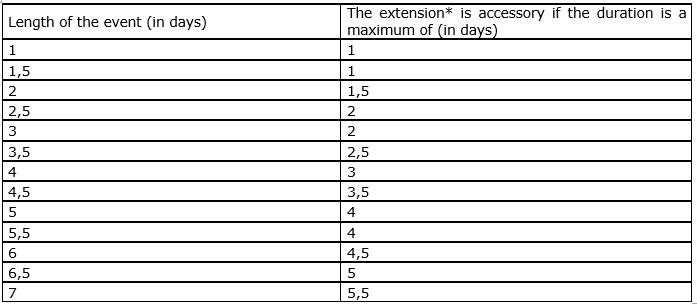
By ‘extension’ it is understood all the days without scientific activity. 

The company must limit its contribution as being towards transport costs linked directly to the scientific event. In concrete terms, the part paid by the company is limited to the fraction of the total cost obtained through multiplying the total travel costs by a fraction of which the numerator corresponds to the official duration of the scientific event in (half)days, and the denominator corresponds to the total duration of the stay, also counted in (half)days.

For example: a doctor participates in a scientific event in Rome for three days and then extends his stay by three days in order to visit the city – a total of 6 days. The company may only fund 3/6ths or half of this healthcare professional’s travel expenses, the other half being at the doctor’s expense.

Important: In the case of a non-accessory extension of stay, it is not sufficient to cover only the outbound or return trip, unless the cost of that trip does not exceed the professional portion of the flight. This must be demonstrated by clearly indicating the total duration of the stay (including the extension for personal reasons) as well as the total price of the outbound and return trip in the visa application so that the aforementioned proportion can be calculated accurately. Only in this way can the professional portion of the flight be calculated relative to the private portion

FAQ 13. The Procedure2026-04-28T11:32:42+00:00

The easiest way is to count backwards; eg: the scientific activities commence on Monday 2 May. If 15 working days are counted backwards from the first working day preceding, ie: from Friday 29th April and then not counting Monday 25th April (Easter Monday Bank holiday) the 15th working day preceding the event will be Friday 8th April. The request may be submitted on that day included, up to midnight (Belgian time – CET).

One has to count backwards from the first official day of scientific activities, even if the participants do not participate on that day.

See also the tool “Calculation of the 15th working day” available on the Mdeon homepage, on the right in the gray frame.

A reduced submission period of 6 working days applies in the following four cases:

  • When the event gathers together a maximum of 15 participants and speakers of any different nationalities IN THE SAME PLACE. It should be noted that this figure represents the TOTAL number of persons concerned by the event (participants, speakers, company representatives – Belgian and foreign, all sessions included, etc..) The reason why the delay of 15 working days is not applicable in this case is because the event concerns a maximum of only 15 persons. In fact, the date of the event can be determined much more quickly than when an event concerns a larger number of participants.
  • When the request for a visa is re-applied for following a substantial modification to the latter (after an initial granting of a visa).
  • When a request for a visa is re-submitted following an initial refusal. It should be noted that this is only valid when the dossier was submitted within the time laid-down. It goes without saying that if the dossier was not submitted within the required time scale of a minimum of 15 working days, the applicant cannot use the reduced time delay of 6 working days.
  • When the visa application concerns a healthcare professional taking part in the scientific meeting as a consultant, which must be demonstrated.

A reduced submission period of 2 working days applies in the case of emergency.

If you -for any reason- were unable to submit a visa application (V1 or V2) in time, you can still submit a visa application using the emergency procedure. This procedure means that you can submit a visa application (V1 or V2) using a shortened deadline of 2 working days prior to the first day of the scientific meeting, provided that the visa application is submitted not later than 12:00 (noon) on the second working day before the start of the meeting. The decision of the Visa Office will then be sent no later than the last working day before the start of the scientific meeting (midnight). A motivation why you are invoking the urgency procedure must not be provided.

For example: if the scientific meeting starts on Thursday December 17, the visa application must be submitted by Tuesday December 15 at noon at the latest. The decision of the Visa Office will then be sent to you on Wednesday December 16 by midnight at the latest (specifically, no later than the last business day before the start of the scientific event).

Travel expenses: once a flight is sponsored (outward and / or return), the justificatif as referred to in FAQ 10.3 must always be attached.

Registration fee: once a company sponsors the participation to a scientific event organised by health professionals, the justificatif as referred to in FAQ 9.4 must always be attached, irrespective of whether or not the registration fee is sponsored and irrespective of whether or not a registration fee is requested.

If a company sponsors the participation of healthcare professionals in scientific events not directly, but through healthcare organisations (hospitals, scientific associations), it concerns an indirect sponsorship of scientific events. In this case, it will be the healthcare organisation that determines which professionals will benefit from the sponsorship.

If it concerns a sponsorship of participation to an event that takes place over several consecutive calendar days (including hospitality) (see FAQ 3), this indirect sponsorship is subjet to the visa obligation: see our brochure in this regard.

In this case, who submits the visa application: the company or the healthcare organisation?
You have the choice:

  • the company can (continue to) submit the visa application itself, as the names of the invited healthcare professionals do not have to be mentioned in the visa application. The healthcare organisation will however have to provide the company with the necessary information to introduce the file.
  • or the visa application is submitted jointly by both the healthcare organisation and the company: the healthcare organisation completes the visa application, encloses the necessary annexes and sends it to the company who checks it, pays for it and introduces it. To find out how to apply for a visa jointly, consult our operating instructions.

een onderneming de deelname van gezondheidszorgbeoefenaars aan wetenschappelijke manifestaties niet op een rechtstreekse, maar via een gezondheidszorgorganisatie (ziekenhuis, wetenschappelijke vereniging) sponsort, dan is er sprake van een onrechtstreekse sponsoring van wetenschappelijke manifestaties. In dat geval zal het de gezondheidszorgorganisatie zijn die bepaalt welke beroepsbeoefenaars de begunstigden zullen zijn van de sponsoring.

Indien het gaat om de sponsoring van deelname aan een meerdaagse bijeenkomst (zie hieromtrent FAQ 3), deze indirecte sponsoring blijft visumplichtig: zie onze brochure hieromtrent.

In dit geval, wie dient de visumaanvraag in: de onderneming of de gezondheidszorgorganisatie? U hebt de keuze:

  • de onderneming kan de visumaanvraag zelf (blijven) indienen aangezien de naam van de uitgenodigde gezondheidszorgbeoefenaars niet in het dossier moeten worden vermeld. De gezondheidszorgorganisatie zal evenwel aan de onderneming de inlichtingen moeten bezorgen die nodig zijn om de visumaanvraag in te dienen.
  • ofwel wordt de visumaanvraag gezamenlijk ingediend door de gezondheidszorgorganisatie én de onderneming: de gezondheidszorgorganisatie vult de visumaanvraag in, voegt er de nodige bijlagen aan toe, verzendt de aanvraag naar de onderneming die ze nakijkt, betaalt en indient. Voor meer uitleg over de gezamenlijke indiening van een visumaanvraag, raadpleeg onze handleiding.

If you have received a visa number, you have to submit a new visa application if your project of sponsorship undergoes a substantial modification between the moment of submitting the visa application and the beginning of the scientific event (art. 22.1 of the Code of Ethics).

In this case a new visa application may be submitted at the latest the 6th or 2nd working day prior to the day the event starts (art. 17.4 and 17.5 of the Code of Ethics).

In general is considered as substantial every modification of which we can reasonably presume that the Visa office should take it into consideration in order to take a decision with full knowledge of the case.

Here are a few examples a substantial modifications, not limitative:

V1 – Sponsorship of participants

  • the number of sponsored participants
    • increases by 3 or more persons (when you have already obtained a visa number for at least 4 persons) and the offered sponsorship remains the same
    • at least doubles (when you’ve already obtained a visa number for 1 to 3 persons) and the offered sponsorship remains the same
    • increases (independent of the number) and the offered sponsorship is different for the additional participant(s)
  • the sponsorship is extended to costs other than those mentioned in the original visa application (addition of transport costs, costs for overnights,…)
  • the hours of arrival or departure alter in an important way (see case by case) if the company sponsors the transport costs, even when the change in hours has no impact on the transport cost
  • the scientific program alters
  • the company sponsors one or more overnights extra
  • the location of the scientific event alters
  • the dates of the scientific event alter and this altering has an impact on the sponsoring
  • in case of a grouped visa application concerning several identical events, an increase of the amount of times the event will take place
  • What about transportation?
    • Local transfers: adding an extra transfer (e.g., taxi, parking, bus, subway) or a more expensive transfer constitutes a substantial change;
    • Main transportation (flight, train):
      • If the price increases between the submission of the visa application and the booking, this is not considered a substantial change provided that all other details remain identical (class, times, destination, date, etc.), even if the price increases by more than 50%. To avoid significant price fluctuations, it is exceptionally permitted to book a flight ticket before the visa has been granted, provided that the ticket is only offered to the invited HCPs after a visa has been obtained.
      • What does constitute a substantial modification: an upgrade, a schedule change that affects the case, a different mode of transportation (e.g., flying instead of taking the train or vice versa), etc.

V2 – Sponsorship of the organizer

  • substantial modification of the budget:
    • additional sponsor(s)*
    • extra costs in the budget (e.g. addition of a social activity)
    • etc.
  • modification of the scientific program
  • modification of the location of the event
  • the dates of the scientific event alter and this altering has an impact on the sponsoring.

* (!) The grouped visa number obtained by the organizer covers only the companies mentioned in the visa application and afterwards in the decision. If one or more sponsors present themselves later their sponsorship will have to be subject to a new visa application (substantial modification). This application can be submitted by the organiser as well as by the company itself. In this last situation, the file number of the organizer has to be mentioned in the visa application in order to allow the Visa Office to link the different applications.

Mdeon has drawn up a checklist that can help you complete a V1 visa application. This checklist provides section by section of the visa application V1 “tips & tricks” to ensure that you do not forget anything. In addition, the corresponding FAQ number is always mentioned, so that in case of doubt you know where you can go for more information.

Click here for the checklist.

FAQ 14. Overseeing of Visa Requirements2026-04-28T11:31:00+00:00
L’Agence Fédérale des Médicaments et des Produits de Santé (A.F.M.P.S.) (The Federal Agency for Medicines and Health Products – F.A.M.H.P.). Mdeon is limited to ensuring an a priori oversight.

In this case contact should be made with the « Contact-Point » put in place by the authorities.

Both the sponsoring company and the healthcare professional receiving the sponsorship will be liable to legal proceedings (punishable by a prison sentence of between 1 month and 1 year and/or a fine of between 1.600 and 120.000 EUR).

In order that the two parties concerned (company and healthcare professional) can be sure that the applicable legal and code of ethic provisions have actually been respected (in view of the existence of penal sanctions which exist in case of non-respect of these provisions).

It is therefore essential that the visa number should appear:

  • in correspondence exchanged between organisers and companies in the case of sponsorship of the organiser of an event
  • in the correspondence exchanged between companies and healthcare professionals in the case of direct sponsorship of participants.
FAQ 15. Technical Tips2025-01-23T18:42:23+00:00
  • The keys Ctrl+F5 allow the programme to be refreshed
  • Never use the key ‘&’ in the title of an appendix in an attachment to a visa request (nor in the ‘route’ leading to the document in your index).
  • Certain headings appearing on the visa application form must be completed or the form cannot be sent. If one of these headings is not applicable in your case, the letters NA (not applicable) should be used in order that the form can be sent.
  • Appendices attached to a visa request must not be greater than 4MB per annexe. If a scientific programme is any heavier, please send it in two parts in distinctly separate pdf documents.
  • If you receive a message saying “this site is not secure??? it will be because your navigator does not possess a Network Solution certificate as used by Mdeon. In order to remedy the problem, you will need to accept our certificate via the link Network Solutions Add Trust External CA Root. Click on « open » then on « Install the certificate ».
Go to Top